


 English
 Español
 عربى
عربى Deutsch
 русский
 Français
What's Driving the Evolution of Dog Leashes & Harnesses?
Content
2026 marks a definitive turning point for the pet traction equipment industry, driven primarily by an unprecedented regulatory shift. The newly revised Public Security Administration Punishments Law, which officially took effect on January 1, 2026, now explicitly mandates that animal owners who fail to implement adequate safety measures face legal consequences if their animals cause harm. This legislative milestone transforms leashes and harnesses from discretionary consumer goods into legally mandated public safety equipment. Industry data already reflects this shift: preliminary surveys indicate that keyword searches for "safety lock harness" and "reflective leash" surged by over 60% year-over-year in the first quarter following enactment. The message is unmistakable: safety compliance has decisively overtaken price as the dominant purchasing driver.
| Decision Factor | 2024 Weight | 2026 Weight | Trend |
|---|---|---|---|
| Price | 38% | 22% | ↓16% |
| Safety Compliance | 27% | 45% | ↑18% |
| Scenario Specialization | 19% | 25% | ↑6% |
| Aesthetic Design | 16% | 8% | ↓8% |
Safety compliance has climbed from 27% to 45% in just two years, while price sensitivity dropped from 38% to 22%. Products featuring anti-escape locking mechanisms, high-visibility reflective elements, and certified tensile strength ratings are positioned to capture this expanding premium segment.
The Outdoor Lifestyle Boom and Its Impact on Traction Gear Standards
Parallel to the regulatory wave, a profound lifestyle shift is reshaping product requirements. The 2026 China Pet Industry White Paper delivers a striking statistic: 71% of surveyed pet owners now express a clear desire to travel with their pets, encompassing weekend hikes, camping trips, and road journeys. This "outdoor togetherness" movement reimagines the leash and harness as multi-environment safety systems rather than simple neighborhood walking aids. A harness adequate for a sidewalk stroll may fail on a rocky trail; a standard nylon leash becomes dangerously slippery when saturated by unexpected rain.
Manufacturers are responding by importing standards from the human outdoor equipment industry. Leash webbing is now being fabricated from ultra-high-molecular-weight polyethylene fibers, offering abrasion resistance cycles exceeding 20,000. Harness fabrics incorporate waterproof-breathable membranes with hydrostatic head ratings surpassing 10,000mm. Modular attachment systems—long standard on hiking backpacks—are now appearing on premium pet harnesses, allowing owners to clip on water bottles, collapsible bowls, and waste bag dispensers.
| Performance Dimension | Urban Daily Grade | Outdoor Professional Grade |
|---|---|---|
| Fabric Abrasion Resistance | 5,000-8,000 cycles | 20,000+ cycles |
| Waterproof Rating | Splash-resistant only | Torrential Rain Level (>10,000mm) |
| Attachment System | Single D-Ring | Multi-Module Magnetic/Carabiner |
| Night Visibility | 50-100m (Reflective) | 300m+ (Active LED + Reflective) |
Smart Features and Human-Centered Innovation
2026 has seen a notable surge in "bidirectional design"—products enhancing both pet comfort and owner convenience. The most emblematic example is the emergence of heated handle leash systems, with manufacturers embedding thin-film heating elements within the grip powered by rechargeable batteries. This addresses a genuine pain point: in northern regions where winter temperatures routinely drop below -15°C, holding a leash for 30 minutes becomes genuinely uncomfortable, discouraging proper exercise for both dog and owner.
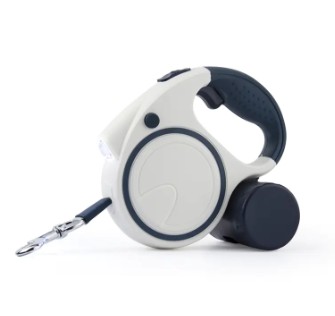
LED lighting systems have evolved from single-mode strips to multi-mode arrays offering constant illumination, slow pulse, and emergency flash patterns, with some models incorporating ambient light sensors for automatic activation at dusk. Storage integration has also matured: 2026 models feature ergonomically contoured compartments seamlessly molded into the handle, capable of holding waste bags or a key without compromising grip comfort.
Material Science and Proper Fit: The Foundations of Safety
Two materials dominate the 2026 premium segment. High-tenacity nylon offers superior elasticity and shock absorption—critical for dogs that pull suddenly—but loses approximately 10-15% of tensile strength when wet and degrades under prolonged UV exposure. High-density polyester exhibits minimal stretch, excellent UV resistance, and virtually no water absorption, making it preferred for rainy climates. Hardware matters equally: forged aluminum locking carabiners maintain structural integrity at loads far exceeding standard zinc-alloy snap hooks, which can deform under sustained tension.
Proper fit is equally critical. The "two-finger rule" provides a baseline, but a correctly fitted harness must meet four criteria: snug enough to prevent backing out, loose enough to avoid restricting shoulder movement, positioned so the chest strap sits across the sternum rather than the throat, and symmetrically adjusted to prevent rotation under load. Owners should recheck fit seasonally, as thick winter coats and weight fluctuations can render a previously perfect adjustment dangerously loose.
Routine Inspection: The Most Overlooked Safety Layer
The single most impactful yet under-practiced safety measure is routine equipment inspection. Nylon webbing exposed to daily UV radiation can lose up to 30% of its original tensile strength within 12 months without showing obvious visual signs. Stitching at high-stress connection points is often the first failure zone, with individual thread fibers breaking incrementally until remaining stitches become critically overloaded.
Pet owners should establish a monthly inspection routine: visually examine all stitching under good light for loose threads or fraying; flex metal hardware to detect cracks; test snap hooks for smooth operation and positive locking; run fingers along webbing to feel for thin spots or internal fiber damage; and verify LED battery compartments remain sealed against moisture. Any component failing inspection should trigger immediate replacement—improvised repairs introduce dangerous weak points.
2026 Buying Guide: A Practical Four-Step Framework
- Audit Your Real Usage Scenarios: Urban sidewalk walks demand different equipment than mountain hikes. Be honest about your actual lifestyle—under-specifying creates risk when you venture beyond normal environments.
- Match Harness Type to Training Stage: Front-clip harnesses offer better control for dogs learning polite leash manners; back-clip harnesses provide greater freedom for well-trained companions. Dual-clip options allow gradual transition as training progresses.
- Verify Quantifiable Safety Claims: Seek products publishing specific tensile strength ratings, abrasion resistance data, and waterproof values. Products declining to provide such data warrant caution.
- Calendar Monthly Inspections: Set a recurring monthly reminder. The ten minutes invested is trivial compared to the potential consequences of equipment failure. Replace proactively, not reactively.
The leash and harness market in 2026 reflects a broader maturation of pet ownership culture. Equipment once selected by color and price is now evaluated through lenses of legal compliance, material science, and failure prevention. A leash is no longer just a strap—it is a safety-critical system deserving serious attention.
NEXT:What supplies do I need to prepare for a kitten that has just arrived home?
Interested in cooperation or have questions?








Whether you need a personalized product or a professional design, our team will bring your ideas to life. Together, let's create a world where pets thrive and are happy!
-
 No.13-1, Haikou Village, Xidian Town, Ninghai Country, Ningbo, China.
 -
 +86 13867893287
 -
 [email protected]
Copyright © Ningbo Welltrop Industrial Products Manufacturing Co., Ltd. All Rights Reserved. China Pet Supplies Manufacturers Wholesale Pet Products Factory
